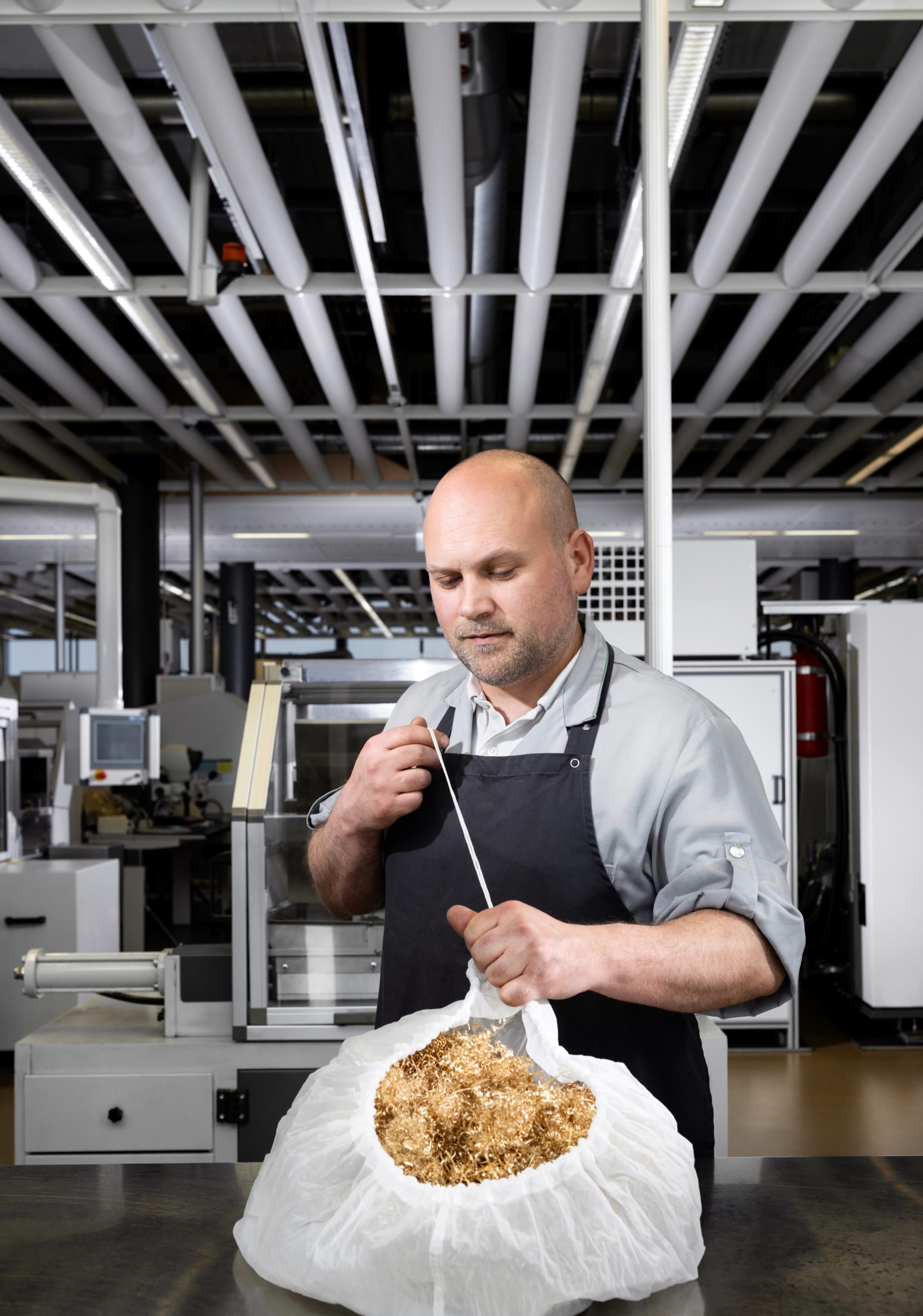
Our gold sourcing and industrial management reflect our commitment to traceability and circularity
We use two types of precious metal supply: mined gold – extracted from large-scale and artisanal mines – and recycled gold – mainly from our own production waste but also, to a lesser extent, from the watchmaking and electronics sectors.
The vertical integration of our industrial model enables us to control all our internal gold processing operations. We have direct access to our refiners – all longstanding and trusted partners – and we keep the number of our subcontractors to a minimum.
We source gold externally in accordance with our specific criteria and manage production flows internally using our own method, achieving a loss rate of virtually zero. This complete control over our manufacturing facilities enables us to optimize every stage of the material processing involved in production, minimize waste and, as a result, significantly reduce our reliance on purchasing gold from external sources.
We trace 99% of our gold – both mined and recycled – and have full control over the origin of the precious metal we purchase up to that percentage. The portion of our supply chain relating to externally purchased, recycled gold (from the watchmaking and electronics sectors) does not allow us to trace the gold back to the mine where it was extracted, but we ensure the traceability of these flows up to our tier 2 suppliers, which is our current objective.
Rolex’s gold model is based on the most efficient possible management of this precious material throughout the various industrial processes. Thanks to our exceptional control over material wastage during the manufacture of our gold parts – with a wastage rate close to zero – we have a business model that is unique in the industry.
Mined gold 9% + Recycled gold 91%
Mined gold
Mined gold refers to gold that we purchase from large-scale mines and ethical artisanal mines located in Peru. We select the mines we wish to work with based on our own social and environmental criteria.
Recycled gold
In the absence of any existing and widely applied industry standard, we have developed our own definition of recycled gold, according to which it comprises both recycled gold purchased on an ad-hoc basis from external sources and circular gold recycled on an ongoing basis in-house.
People-centric
At Rolex, anyone who comes into contact with gold – particularly in the foundry, finishing, stamping, machining, heat treatment and final finishing processes – receives specific training, which determines their access to the precious metal and is tailored to their specific role. This training model, which is regularly audited internally, is based on empowering each operator throughout the production line.
Because human capital and industrial expertise are Rolex’s two greatest assets, we have chosen to develop our own machinery. Designed to assist and support our operators in their day-to-day work, these tools also reflect our ongoing commitment to the comfort and well-being of our staff.
For example, our foundry has recently been equipped with new ‘automatic continuous casting shot-blasting machines’, which eliminate the need for physically demanding manual labour. With this new system, the operator no longer has to manually switch the shot and only handles the product at the end of the processing stage.
Mines
Our Purchasing department is tasked with ensuring a balance between our purchases of mined gold and recycled gold when sourcing from external suppliers. It also aims to source this precious material in the most socially and environmentally responsible way possible.
We source our mined gold from both large-scale and artisanal mines. On a yearly basis, we work directly with our refiners to select the mines we wish to include or exclude from our panel, where applicable.
Countries of origin of Rolex’s mined gold
1. Canada
2. United States
3. Peru
4. Chile
5. Argentina
6. Sweden
7. Finland
Traceability
By ‘tracing’ the gold, we guarantee and document the origin and digital tracking of the physical movements of each batch of precious metal. We have implemented our own traceability system, externally audited in accordance with the ISAE 3000 Type 1 standard, which allows us to identify all the steps in the life cycle of yellow gold: extraction, pre-refining, transport and refining. The control procedure includes site visits by buyers, as well as the installation of segregated equipment at all refiners in order to avoid any mixing within the supply chain. This exclusive channel is an added guarantee of traceability through to delivery at Rolex.
Governance
Gold governance is overseen internally by the Precious Metals Committee, as well as by a Sourcing Committee for each refiner – an entity open to our external partners and composed of our managers and the supplier’s managers.
All our requirements regarding precious metals are set out in contracts. We also receive monthly reports from our refiners, which enable us to verify that the origin of the gold meets our requirements.
Recycling of manufacturing waste
For us, every gram of gold recovered is one less gram of gold that needs to be mined. We have therefore developed our own methodology, unrivalled in the industry, for recovering and sorting our own gold waste (offcuts, shavings and dust).
To minimize losses as much as possible during the various stages of production, we have also developed a strict gold monitoring system involving systematic weighing at every stage of the process, which also relies on employees taking responsibility at all times: the precious material entrusted to an operator is weighed at each workstation using a computerized system, with an extremely low tolerance threshold for losses, defined for each sector. At the end of this process, the employee hands over responsibility for the precious material to the next operator. The computerized monitoring of each production order records all this information, which is then consolidated during stock-taking.
Integration and autonomy
We have our own precious metal foundry where we create our alloys. In addition, in 2014 we established our own independent laboratory for the analysis of precious metals (gold, silver, platinum and palladium) and have our own in-house certified assayers.
We currently employ four sworn assayers, all of whom have been trained by the Precious Metals Control Office (BCMP) within the Federal Office of Customs and Border Security (OFDF). Our laboratory is certified by the ISO 17025* standard.